
Yoga Nidra for Stress Relief: What I Actually Felt After My First Session
Yoga Nidra for Stress Relief – Is It Really That Effective?
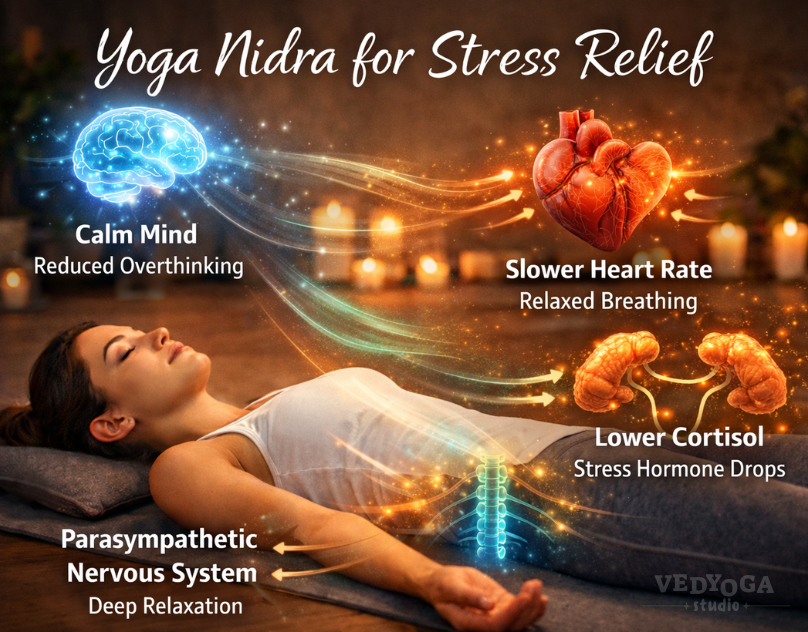
Yoga Nidra for stress relief is something I didn’t take seriously at first.
I tried it during a class, mostly because it was part of the session. I wasn’t expecting anything different. In my mind, it was just another “lie down and relax” activity.
But that one session changed how I look at relaxation.
Stress, for me, usually shows up as overthinking. Even when I’m resting, my mind keeps going. That day, for the first time in a while, things slowed down.
What Yoga Nidra Actually Is (No Complicated Terms)
Yoga Nidra is very simple on the surface.
You lie down, close your eyes, and follow a guided voice. That’s it.
There’s no need to control your breath or force your mind to stay still. You just listen as your attention moves through different parts of the body, sometimes along with breath awareness or small visualizations.
At some point, your body becomes deeply relaxed, almost like sleep — but you’re still aware of what’s happening.
That in-between state is what people call Yoga Nidra.
What Happened When I Tried It
In the beginning, I was distracted.
I remember thinking about random things — how long the session would take, whether I was doing it correctly, small unnecessary thoughts.
Then slowly, without me trying anything, my body started to relax.
It felt heavy. Not uncomfortable, just still. Like I didn’t need to move at all.
My breathing became slower on its own.
And the biggest thing — my mind stopped reacting to every thought. The thoughts were still there, but they didn’t feel loud.
After the session ended, I didn’t feel sleepy.
I felt calm.
That difference was noticeable… and it happened in the first class itself.
Why Yoga Nidra Helps with Stress (What I Learned Later)
After that experience, I got curious and looked into why it felt that way.
There are studies showing that Yoga Nidra can reduce cortisol, which is the hormone linked to stress. One of them is published in the International Journal of Yoga.
Lower cortisol usually means your body is not constantly in a stressed state.
I also came across research from All India Institute of Medical Sciences where people practicing Yoga Nidra showed reduced anxiety and better sleep.
And according to findings supported by National Institutes of Health, this practice helps activate the body’s relaxation response — the parasympathetic nervous system.
I didn’t know any of this during my first session, but it explains what I felt.
Why It Felt Easier Than Other Practices
I’ve tried basic meditation before.
It helps, but it also feels like effort — bringing the mind back again and again.
Yoga Nidra didn’t feel like that.
There was nothing to fix, nothing to control. Even if my mind wandered, it didn’t feel like I was doing something wrong.
That made it easier to stay with the process.
What You Might Notice with Regular Practice
From what I’ve experienced and seen in others:
- the body relaxes more deeply
- thoughts slow down without force
- sleep improves over time
- emotional heaviness feels lighter
It’s not something dramatic or instant every day, but it builds up quietly.
How to Try Yoga Nidra for Stress Relief
You don’t need much to start.
- lie down comfortably
- close your eyes
- follow a guided session
- let things happen naturally
Around 20–30 minutes is enough.
Some days your mind will be calm, some days it won’t. That’s fine.
Is Yoga Nidra Actually Worth Trying?
If I’m being honest, I would still rate Yoga Nidra for stress relief quite high.
Not because it’s perfect, but because it’s simple and accessible. You don’t need experience, and you can feel a difference early on.
For me, that first session was enough to understand that this practice works in a quiet but real way.
What made me trust it more was coming across actual research on Yoga Nidra for stress relief. A study published in the International Journal of Yoga explains how Yoga Nidra helps reduce cortisol levels (the primary stress hormone), which directly impacts how the body handles stress — you can read the research here: Yoga Nidra for stress relief
There’s also clinical research from All India Institute of Medical Sciences showing reduced anxiety and improved sleep quality with regular Yoga Nidra practice, which supports its use for mental relaxation: Effectiveness of Yoga Nidra in reducing stress
For a broader understanding, studies referenced by the National Institutes of Health highlight how deep relaxation techniques like Yoga Nidra activate the parasympathetic nervous system, helping the body shift from stress mode to recovery mode:
I didn’t know any of this when I first tried it, but after reading these studies, it made sense why I felt calmer without putting in much effort.
Final Thought
Yoga Nidra for stress relief didn’t feel special in the beginning.
But by the end of that first session, something had clearly changed — even if it was small.
And sometimes, small shifts are enough to make you come back to a practice.
Don’t just read about relaxation — experience it.
Start your journey with our 21-Day Stress Relief Yoga Program and transform your stress into calm.
FAQs – Yoga Nidra for Stress Relief
1. What is Yoga Nidra for stress relief?
Yoga Nidra for stress relief is a guided relaxation practice where you lie down and follow instructions that help your body and mind deeply relax. It allows your nervous system to shift out of stress mode and enter a calm, restorative state.
2. Does Yoga Nidra really reduce stress?
Yes, Yoga Nidra is known to reduce stress by calming the mind and lowering cortisol levels. Many people notice a sense of relaxation even after the first session, while deeper benefits come with regular practice.
3. How long should I do Yoga Nidra for stress relief?
For effective stress relief, 20 to 30 minutes of Yoga Nidra is usually enough. Even shorter sessions can help, but consistency matters more than duration.
4. Can beginners practice Yoga Nidra?
Yes, Yoga Nidra is one of the easiest practices for beginners. There is no need for prior experience, flexibility, or meditation skills — you simply follow a guided session.
5. Is Yoga Nidra better than meditation for stress relief?
Yoga Nidra and meditation both help with stress, but Yoga Nidra is often easier for beginners because it requires less effort. You don’t need to control your thoughts, which makes it more accessible.