
Bhramari Pranayama for Stress Relief: A Practical and Science-Based Approach
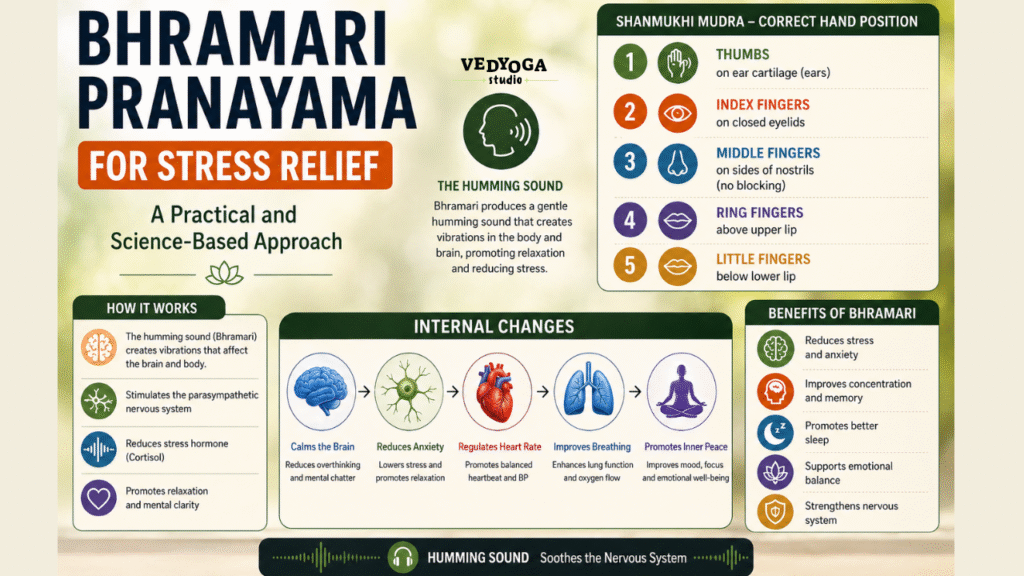
Bhramari pranayama for stress relief may look like a very basic practice at first. It doesn’t involve complex poses or long routines. But when someone sticks with it for a few days, they usually start noticing a difference—not outside, but in how their mind reacts to things.
In most conversations I’ve had with working professionals, one thing comes up again and again. It’s not that they don’t know what to do. They’ve heard about meditation, breathing, taking breaks. The problem is that none of it feels easy to continue.
That’s where Bhramari feels different.
Bhramari pranayama for stress relief looks very simple when you first hear about it. There’s nothing complicated in it. No difficult poses, no long routine. But when someone actually tries it for a few days, they start noticing something small but real — their reactions change.
Not the situation. Just how they respond to it.
In most of my conversations with working professionals, I’ve noticed something common. People already know they should relax, breathe, maybe meditate. It’s not lack of information. The problem is, they don’t continue anything for long.
It either feels like too much effort or just doesn’t fit into their routine.
Bhramari is different in that sense.
It doesn’t demand much. You don’t need a proper setup or a fixed schedule. You just sit wherever you are comfortable and follow a simple breathing pattern. That’s probably why people don’t drop it easily.
At Vedyogastudio, we usually begin with this practice. Not because it is advanced, but because people actually stick with it.
Meaning of Bhramari Pranayama
If I explain it in the simplest way, Bhramari is just a way of breathing where you inhale normally through your nose and then let the breath out slowly while making a soft humming sound.
That’s it. Nothing complicated.
If you actually sit and try it, you’ll probably notice a small vibration around your face—mostly near the nose or forehead area. In the beginning, it can feel a little strange. But after a few rounds, your mind kind of settles into that feeling without you forcing it.
The name comes from the sound—it’s similar to a bee. But honestly, the sound itself is not that important. It’s just a tool to slow your breathing down.
What Actually Happens in the Body
A lot of practices say they reduce stress, but they don’t really explain what is changing inside.
1. With Bhramari, the first thing that changes is your breathing rhythm.
When you add that humming, your exhale naturally becomes longer. You don’t have to control it too much—it just slows down on its own. And when your exhalation slows, your body starts to relax without much effort.
There’s also some research that says humming can increase nitric oxide in the nasal passages, which helps with airflow. But in real experience, most people don’t notice that part directly.
What they do notice is this—
their mind feels a little quieter than usual.
Not completely silent, but less intense.
And for someone who is used to constant thoughts, even that small difference feels meaningful.
More importantly, the slow and extended exhalation changes your breathing pattern from fast and reactive to slow and controlled.
This shift alone has a calming effect.
Reference: Nitric Oxide, Humming and Bhramari Pranayama
2. Nervous system response
When breathing slows down, the body gradually shifts from an alert state to a relaxed state.
Studies available through National Center for Biotechnology Information explain how slow breathing activates the parasympathetic nervous system.
In simple terms, your body moves out of “constant alert mode.”
3. Effect on anxiety and mental activity
Clinical observations published on PubMed show that regular pranayama practice is linked with reduced anxiety and better emotional control.
This is not because thoughts disappear, but because your reaction to them changes.
Bhramari vs Normal Breathing
| Aspect | Bhramari | Normal Breathing |
| Speed | Slow and deliberate | Unconscious, often fast |
| Exhalation | Longer and controlled | Short |
| Mental state | Settled | Distracted |
| Awareness | Higher | Low |
You don’t need a perfect setup.
Sit wherever you are comfortable. Close your eyes if that helps.
Inhale normally through your nose. Then exhale slowly while making a low humming sound. It should not be loud or forced.
The important part is not the sound—it is the steadiness of the exhale.
Start with five minutes. That is enough.
What I’ve Seen in Practice
Instead of promising outcomes, it is more useful to describe what actually happens with regular practice.
Case 1: Office worker with constant mental noise
One person I worked with mentioned that even after work, their mind would keep replaying conversations and tasks.
They started doing Bhramari for a few minutes before sleeping.
After about a week, they didn’t say their thoughts disappeared. They said the thoughts felt “less loud.”
That distinction matters.
Case 2: Student dealing with exam stress
Another case involved a student who felt anxious before sitting down to study.
They began doing Bhramari for a few minutes before starting.
The change was not dramatic, but they were able to sit longer without getting distracted.
Case 3: Professional experiencing burnout
This person was not looking for relaxation—they were simply exhausted.
With short sessions in the morning and evening, the first change they noticed was not calmness, but reduced irritation.
That is often the first visible shift.
Benefits You Can Expect (If Practiced Consistently)
Mental
- Slight reduction in overthinking
- Better ability to stay with one task
- Less mental restlessness
Physical
- Slower breathing pattern
- Reduced tension in face and jaw
- More stable energy levels
Emotional
- Less reactive behavior
- Gradual sense of control
- Improved patience
Why This Works for Working Professionals
Most stress today is not physical. It is a mental overload. You don’t need a complex solution for that. You need something that interrupts the pattern.Bhramari works because it creates a pause.Not a long break. Just enough to reset.
A Simple Way to Include It in Your Day
| Time | What to do |
| Morning | 5 minutes after waking up |
| During work | 2–3 minutes when overwhelmed |
| Night | 5 minutes before sleep |
This is realistic. Anything more usually does not sustain.
Common Mistakes
People usually drop this practice because they overdo it or expect quick results.
- Trying to make the sound perfect
- Practicing irregularly
- Treating it like a task instead of a pause
Consistency matters more than technique perfection.
How We Approach This at Vedyogastudio
At Vedyogastudio, we don’t isolate techniques.
Bhramari is introduced as part of a routine that includes simple movement and short periods of stillness.
This makes it easier to continue without feeling like it is another task on your list.
Conclusion
Bhramari pranayama for stress relief is not a dramatic practice.It does not promise instant calm or remove stress from life.
What it does is more subtle.It changes how you experience stress.And over time, that change becomes noticeable in how you think, react, and feel.
FAQs –Bhramari Pranayama for Stress Relief
1. How long should I do Bhramari for stress relief?
Practice for 5–10 minutes daily for noticeable calming effects.